The global job market stands at a precipice, undergoing a transformation so profound it redefines the very essence of human labor. Driven by exponential advancements in artificial intelligence, automation, and digital connectivity, the traditional paradigms of employment are rapidly dissolving. This necessitates a critical examination of the future of work, not merely as an academic exercise but as an urgent imperative for policymakers, businesses, and individuals alike. The coming decades promise not just disruption, but a fundamental restructuring of industries, demanding unprecedented adaptability and a proactive approach to skill development.
The Relentless March of Automation and AI
The impact of automation and artificial intelligence on employment is no longer a theoretical debate; it is a quantifiable reality. The World Economic Forum’s Future of Jobs Report 2023 projects a net decrease of 14 million jobs globally over the next five years, translating to 2% of current employment. While approximately 69 million new jobs are expected to be created, a more significant 83 million are anticipated to be eliminated.
This displacement is not uniform, impacting routine and repetitive tasks across various sectors with particular intensity. Manufacturing, administrative, and data entry roles are especially vulnerable to AI-driven automation. However, AI also acts as a job creator, fostering demand for roles in AI development, ethical AI oversight, and human-AI collaboration specialists.
Furthermore, an International Labour Organization (ILO) analysis from 2023 indicates that while generative AI is likely to augment 50% of tasks, only a small fraction of jobs (around 0.5% globally) are fully exposed to automation. This nuanced perspective underscores the shift towards task-level automation rather than wholesale job elimination, demanding a re-evaluation of job design and workflows.
The Evolving Landscape of In-Demand Skills
As machines increasingly handle predictable tasks, the premium on uniquely human capabilities intensifies. The World Economic Forum’s 2023 report identifies analytical thinking and creative thinking as the two most critical skills for the next five years, with 10% and 8% of companies, respectively, expecting them to grow in importance. These cognitive skills are essential for navigating complex, novel challenges that AI cannot yet address.
Beyond cognitive prowess, socio-emotional skills such as resilience, flexibility, agility, motivation, and self-awareness are gaining significant traction. These ‘soft skills’ are foundational for effective teamwork, leadership, and adaptability in rapidly changing environments. The ability to collaborate effectively with AI systems, interpret their outputs, and exercise judgment where algorithms fall short is becoming indispensable across nearly all professions.
Moreover, specialized digital skills, including AI and Big Data expertise, cybersecurity, and digital marketing, continue their upward trajectory. However, the overarching trend points to a synthesis: individuals who can combine advanced technical proficiency with robust critical thinking and interpersonal skills will be best positioned for future employment.
Reskilling and Upskilling: A Mandate for Survival
The burgeoning skills gap necessitates a comprehensive and continuous commitment to learning and development. Estimates from McKinsey & Company suggest that by 2030, over 100 million workers in eight major economies may need to switch occupations due to automation. This scale of transition demands proactive strategies from both employers and governments.
Corporate investment in reskilling programs is no longer a luxury but a strategic imperative. Companies that prioritize internal talent development can mitigate recruitment costs and foster employee loyalty, while simultaneously building a future-ready workforce. For instance, Singapore’s SkillsFuture initiative exemplifies a national commitment to lifelong learning, providing subsidies and support for citizens to acquire new skills and adapt to economic shifts.
Individuals, too, bear a significant responsibility for their own career agility. Embracing a mindset of continuous learning, seeking out relevant certifications, and actively participating in online courses are crucial. The half-life of skills is shrinking, making static knowledge obsolete; dynamic skill acquisition is the new norm for professional longevity.
The Rise of Flexible Work Models and the Gig Economy
The COVID-19 pandemic catalyzed an unprecedented shift towards remote and hybrid work models, a trend that shows no signs of significant reversal. A 2023 Gallup report indicates that 52% of remote-capable employees in the U.S. prefer a hybrid arrangement, while 32% prefer to be entirely remote. This preference reshapes expectations for work-life balance and geographical flexibility, impacting urban planning and corporate real estate strategies.
Concurrently, the gig economy continues its robust expansion, offering individuals greater autonomy and diverse income streams. The global gig economy market is projected to reach a gross volume of 455 billion U.S. dollars by 2023, driven by platforms connecting freelancers with short-term projects. While offering flexibility, the gig economy also presents challenges related to income stability, benefits access, and worker protections.
These evolving work models demand a recalibration of employment law, social safety nets, and organizational culture. Companies must develop robust frameworks for managing dispersed teams, fostering engagement, and ensuring equitable treatment for all types of workers, whether full-time, part-time, or freelance.
Human-AI Collaboration: The New Paradigm
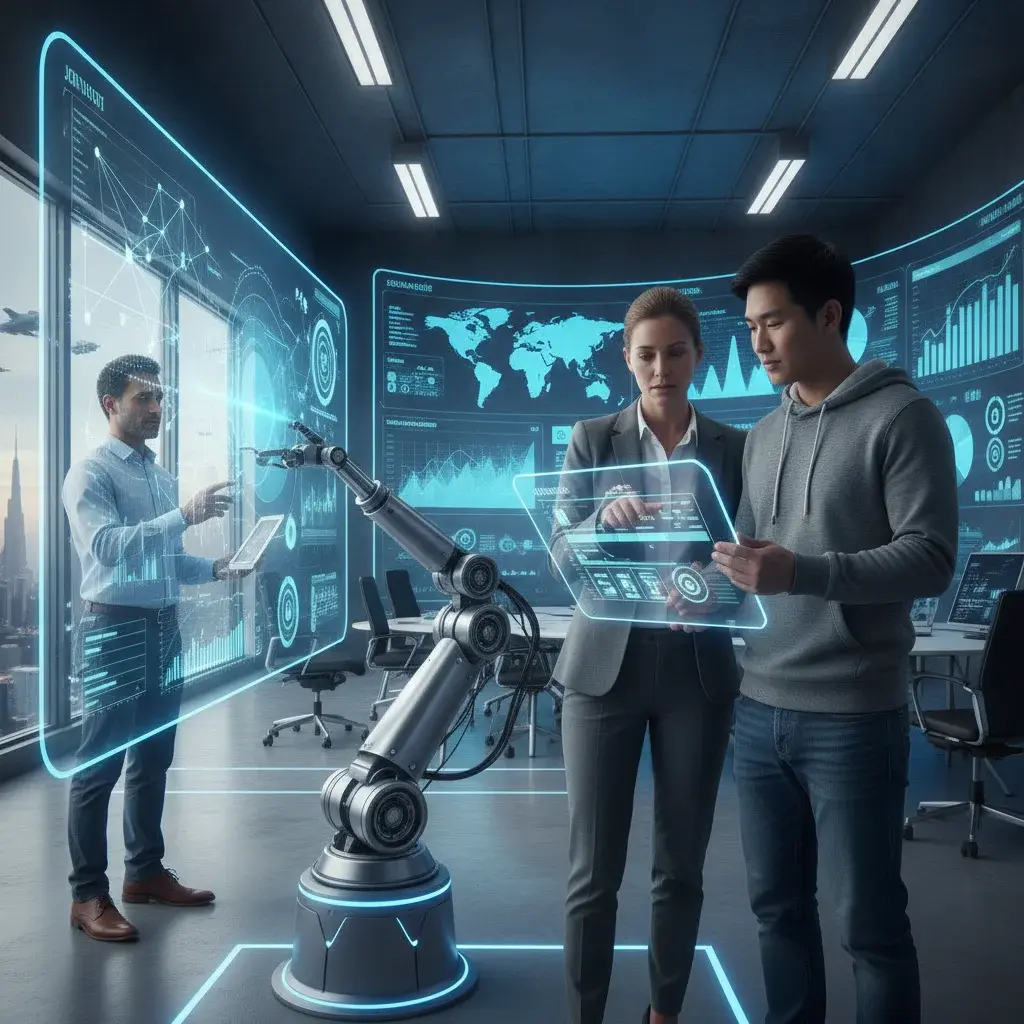
The most pragmatic perspective on AI’s role in the workplace is not one of replacement, but of augmentation. Instead of viewing AI as a competitor, a more productive approach frames it as a powerful tool for enhancing human capabilities. This human-AI collaboration paradigm is already evident in numerous sectors.
In healthcare, AI assists radiologists in detecting anomalies in medical images with up to 90% accuracy, often surpassing human capabilities alone. However, the final diagnosis and patient interaction remain the exclusive domain of human physicians. Similarly, in finance, AI algorithms can process vast datasets to identify market trends, yet strategic investment decisions require human intuition, ethical judgment, and client relationship management.
This collaborative model necessitates new skill sets centered on ‘AI literacy’ – understanding how AI works, its limitations, and how to effectively leverage its power. The future workforce will not be defined by those who work independently of AI, but by those who can fluidly integrate AI tools into their workflows to amplify their productivity and problem-solving capacity.
Policy Imperatives for a Just Transition
Navigating the complexities of the future of work demands proactive and comprehensive policy interventions. Governments must play a pivotal role in ensuring a just transition, mitigating the adverse effects of automation, and harnessing its benefits for societal good. This includes significant investment in public education systems, emphasizing future-ready skills from an early age.
Furthermore, policymakers must explore innovative social safety nets designed for a more dynamic and potentially fragmented labor market. Discussions around universal basic income (UBI), portable benefits, and enhanced unemployment support are gaining traction as potential mechanisms to provide stability during periods of transition and retraining. Robust regulatory frameworks are also essential to address ethical concerns surrounding AI, data privacy, and algorithmic bias in hiring and management.
International cooperation on labor standards and skill recognition will also be crucial as global supply chains and remote work blur national boundaries. A fragmented approach risks exacerbating inequalities and hindering the collective ability to adapt to these profound shifts.
Conclusion
The transformation of the global job market is not a distant threat but an ongoing reality, driven by technological forces that are both disruptive and immensely promising. A critical, analytical stance reveals that while job displacement is inevitable in certain sectors, the potential for new job creation and augmented human productivity is equally significant. Success in this evolving landscape hinges upon an unwavering commitment to continuous learning, strategic investment in skill development, and the cultivation of adaptable, resilient workforces. The future of work is not predetermined; it is being actively shaped by the collective decisions and proactive measures taken today by individuals, businesses, and governments.