Artificial Intelligence in Education for Personalized Learning is reshaping how knowledge is delivered, assessed, and scaled across digital and physical classrooms, replacing standardized instruction with adaptive systems that respond to individual cognitive patterns, pace, and skill gaps. Education is shifting from curriculum-centered delivery toward learner-centered optimization driven by data modeling, automation, and real-time feedback loops.

Trending Education Keywords Shaping This Shift
artificial intelligence education, personalized learning platforms, adaptive learning systems, learning analytics, digital classrooms, online education, microlearning, skills based education, educational technology, lifelong learning
Artificial Intelligence in Education for Personalized Learning as the Core Engine
Data-Driven Learner Modeling
AI-powered platforms construct dynamic learner profiles using behavioral data, assessment results, engagement metrics, and content interaction history. These models continuously evolve as students progress.
Systems such as those described by Stanford Graduate School of Education demonstrate how algorithms predict mastery levels and content readiness with high accuracy.
Key mechanisms include:
- Knowledge tracing algorithms mapping concept mastery
- Natural language processing analyzing written responses
- Pattern recognition detecting disengagement
- Predictive analytics forecasting performance risks
This infrastructure replaces static grading with living cognitive maps.
Adaptive Content Sequencing
Instead of fixed lesson plans, AI systems reorder content based on comprehension velocity and difficulty thresholds.
Platforms integrating adaptive pathways similar to those outlined by Khan Academy’s mastery learning model adjust exercises in real time to eliminate knowledge gaps before progression.
Outcomes include:
- Reduced learning plateaus
- Faster remediation cycles
- Personalized challenge calibration
- Higher concept retention
Instruction becomes algorithmically responsive.
Intelligent Tutoring Systems and Automated Feedback
Real-Time Instructional Support
AI tutors simulate one-on-one instruction at scale. These systems diagnose misconceptions instantly and intervene with targeted explanations.
Research summarized by MIT Technology Review shows AI tutors improving problem-solving efficiency by delivering immediate corrective scaffolding.
Functional layers include:
- Concept error detection
- Context-aware hint generation
- Progressive difficulty tuning
- Performance benchmarking
Students receive continuous micro-feedback loops.
Automated Assessment Precision
Traditional exams measure outcome snapshots. AI assessment systems measure learning trajectories.
Learning analytics frameworks discussed by OECD education innovation reports emphasize formative analytics tracking growth, struggle patterns, and mastery depth.
Capabilities include:
- Essay evaluation through semantic analysis
- Skill demonstration scoring
- Behavioral engagement indicators
- Competency mapping
Assessment shifts from grading to performance engineering.
Learning Analytics as the Infrastructure of Personalization
Behavioral Intelligence in Classrooms
AI systems aggregate massive interaction datasets across platforms, courses, and timeframes.
Educational analytics platforms like those referenced by EdTech Review transform clickstreams, time-on-task, and response accuracy into actionable teaching intelligence.
Metrics typically tracked:
- Concept dwell time
- Reattempt frequency
- Cognitive load signals
- Attention decay curves
Teachers gain precision intervention tools.
Predictive Risk Management
Machine learning models forecast dropout risk, comprehension collapse, and motivation decline.
Universities using analytics strategies outlined by Educause identify vulnerable learners weeks before failure occurs.
Interventions become:
- Targeted tutoring
- Content restructuring
- Engagement prompts
- Personalized support plans
Retention increases through proactive systems.
AI-Powered Personalized Learning Platforms
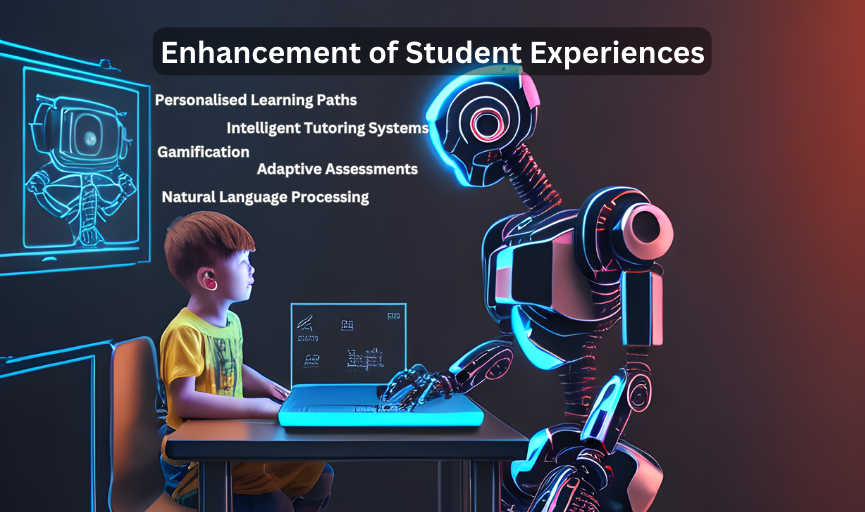
Modular Skill-Based Pathways
Modern education increasingly abandons linear grade systems for competency-driven progression.
Online learning ecosystems such as those detailed by Coursera’s skills transformation framework deploy AI to recommend learning paths aligned with career outcomes.
Features include:
- Skill gap diagnostics
- Course stacking optimization
- Mastery verification
- Credential personalization
Learning becomes outcome-engineered.
Microlearning and Content Atomization
AI breaks curricula into micro-units optimized for attention span and memory consolidation.
Research shared by Harvard Graduate School of Education highlights higher retention rates when content is delivered in short adaptive bursts.
Microlearning systems enable:
- Just-in-time knowledge delivery
- Rapid skill refresh cycles
- Personalized revision loops
- Cognitive load management
Efficiency replaces volume-based instruction.
Ethical, Cognitive, and Systemic Implications
Bias and Algorithmic Fairness
AI models learn from historical data, inheriting systemic educational inequities.
UNESCO’s guidance on ethical AI in education outlined at UNESCO AI policy frameworks stresses transparency, inclusivity, and accountability.
Risks include:
- Socioeconomic data distortion
- Cultural content bias
- Over-personalization limiting exposure
- Reinforcement of performance labeling
Mitigation requires diverse datasets and human oversight.
Cognitive Autonomy and Dependency
Over-automation risks reducing metacognitive development.
When systems constantly guide difficulty and pacing, learners may lose self-regulation skills.
Balanced models preserve:
- Independent problem solving
- Goal-setting capacity
- Reflective learning practices
- Critical thinking autonomy
AI must augment, not replace, human cognition.
Institutional Transformation and Future Classrooms for Artificial Intelligence in Education
Teacher Roles Redefined
Educators shift from content deliverers to learning architects.
AI handles:
- Routine assessment
- Content pacing
- Data monitoring
Teachers focus on:
- Mentorship
- Conceptual coaching
- Emotional intelligence
- Complex reasoning facilitation
Human instruction becomes higher-order.
Scalable Global Education Access
Personalized Artificial Intelligence in Education enables mass quality education delivery at minimal marginal cost.
Platforms supporting remote learning expansion similar to models discussed by World Bank education technology initiatives extend adaptive learning to underserved regions.
Outcomes include:
- Language-adaptive content
- Low-bandwidth optimization
- Skill-based employability pathways
- Continuous lifelong learning access
Education becomes borderless and individualized.
Structural Architecture of a Personalized Artificial Intelligence in Education
Core Components
Data Layer
- Student interaction logs
- Performance metrics
- Content metadata
Intelligence Layer
- Machine learning models
- Recommendation engines
- Predictive analytics
Experience Layer
- Adaptive dashboards
- Personalized lesson flows
- Real-time feedback interfaces
This tri-layer system drives continuous optimization.
Measurable Impact on Learning Outcomes
Studies aggregated by McKinsey education analytics report:
- Increased mastery speed
- Reduced achievement gaps
- Higher learner engagement
- Improved long-term retention
AI personalization consistently outperforms standardized instruction models.
Long-Term Educational Evolution
Artificial Intelligence in Education for Personalized Learning is not a technology upgrade but a systemic shift toward precision education engineering.
Key transformations underway:
- From curriculum pacing to mastery pacing
- From generalized teaching to individualized pathways
- From static testing to continuous analytics
- From classroom boundaries to lifelong learning ecosystems
Education evolves into a responsive cognitive infrastructure designed around human variability rather than institutional convenience.
The future classroom operates as an adaptive intelligence network, optimizing every learner’s trajectory in real time through data, automation, and human-guided cognition.
This model defines the next educational era.