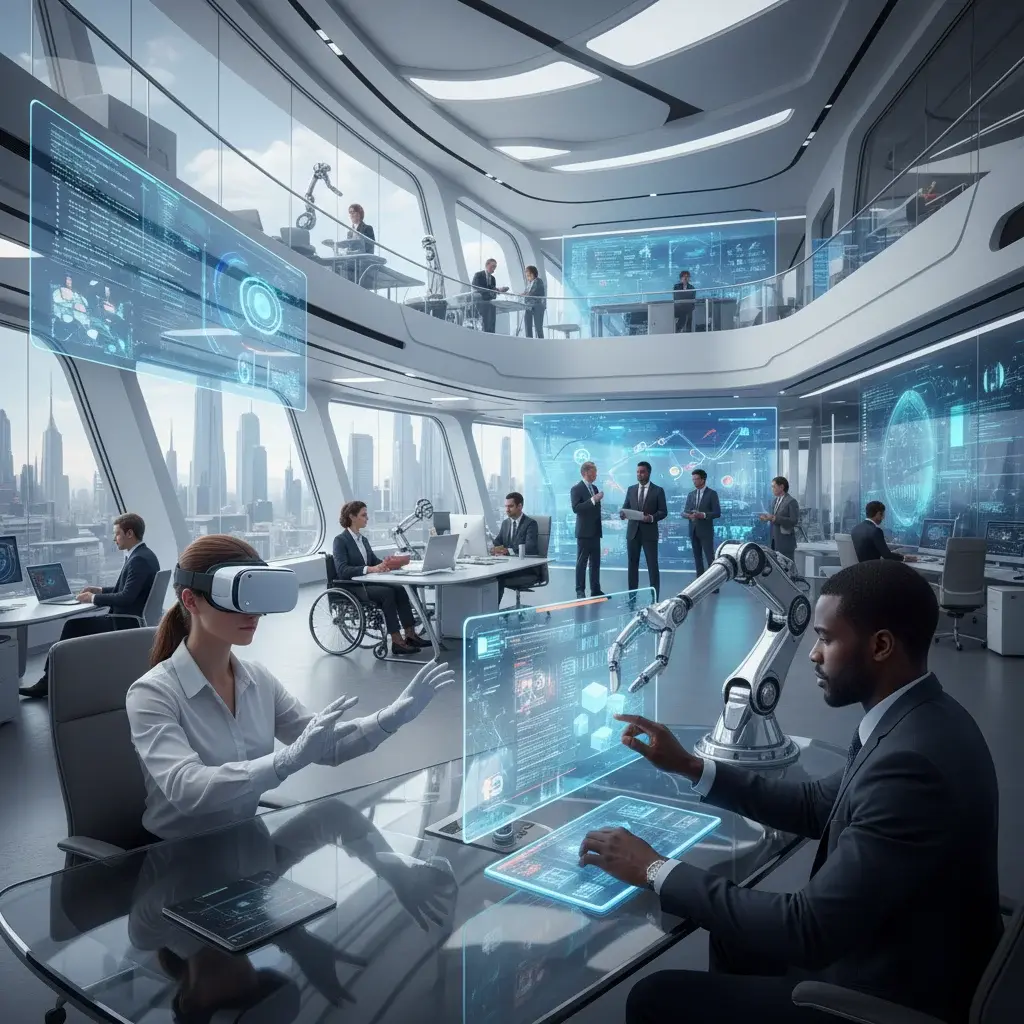
The global labor landscape is undergoing a seismic shift, driven by technological acceleration, demographic changes, and evolving societal expectations. This transformation, often termed the future of work, presents both unprecedented opportunities and significant challenges, demanding a rigorous, analytical critique rather than mere observation. Understanding the fundamental forces at play is crucial for individuals, businesses, and policymakers alike to navigate this complex terrain effectively.
The Accelerating Pace of Automation and AI Integration
Automation and artificial intelligence (AI) are not just buzzwords; they are tangible forces reshaping job functions and entire industries. The World Economic Forum’s Future of Jobs Report 2023 projects that 23% of jobs globally are expected to change in the next five years, with 69 million new jobs created and 83 million eliminated. This net reduction underscores a critical re-evaluation of human-machine interaction within the workplace.
The impact extends beyond manufacturing, permeating service sectors, administrative roles, and even some professional domains. Repetitive, rule-based tasks are particularly susceptible to automation, leading to increased efficiency but also significant job displacement. This necessitates a proactive strategy for workforce adaptation, moving beyond reactive measures.
Redefining Productivity and Value Creation
The integration of AI tools promises to redefine productivity benchmarks. Tasks that once required extensive human effort, such as data analysis, content generation, and customer service, are increasingly augmented or entirely performed by AI. This shift compels organizations to re-evaluate how value is created and where human capital can be most effectively deployed.
The focus is moving towards roles that leverage uniquely human attributes: creativity, critical thinking, complex problem-solving, emotional intelligence, and interpersonal communication. While AI can process vast datasets, the nuanced interpretation, ethical considerations, and strategic application often remain within the human domain, at least for the foreseeable future. However, even these domains are under increasing algorithmic influence, warranting careful scrutiny of AI’s expanding capabilities.
The Persistent and Widening Skills Gap
A critical impediment to workforce adaptation is the pervasive and widening skills gap. As technology advances, the demand for new competencies outpaces the supply of qualified individuals. The European Centre for the Development of Vocational Training (Cedefop) consistently highlights the mismatch between educational outputs and labor market needs, particularly in digital and green skills.
Many educational institutions struggle to adapt curricula rapidly enough to meet the dynamic requirements of emerging industries. This inertia creates a lag, leaving graduates with skills that are either obsolete or insufficiently developed for the roles of tomorrow. Consequently, businesses face chronic shortages in key areas, hindering innovation and growth.
The Imperative of Lifelong Learning and Reskilling Initiatives
Addressing the skills gap demands a fundamental shift towards a culture of continuous, lifelong learning. The notion that education concludes with a degree is demonstrably outdated. Individuals must embrace ongoing upskilling and reskilling to remain relevant in a fluid job market. This responsibility, however, cannot fall solely on the individual.
Corporations bear a significant responsibility to invest in their workforce’s development. Programs focused on reskilling employees for new roles within the organization, or upskilling them to leverage new technologies, are not merely altruistic gestures but strategic necessities. For example, McKinsey & Company’s report on The future of work in Europe estimates that by 2030, 94 million European workers may need to change occupations, underscoring the scale of this reskilling challenge.
Government initiatives, such as those outlined in the OECD Skills Strategy 2019, are also vital. These programs often focus on accessible vocational training, digital literacy initiatives, and partnerships between educational bodies and industry to ensure curriculum relevance. Without concerted effort across all sectors, the skills gap will continue to exacerbate economic inequalities and impede progress.
The Rise of the Gig Economy and Flexible Work Models
The traditional employment model, characterized by full-time, long-term contracts, is increasingly being supplemented by the rise of the gig economy and diverse flexible work arrangements. A 2021 Pew Research Center study revealed that 16% of U.S. adults had earned money through an online gig platform, indicating a significant, albeit often precarious, segment of the workforce.
This shift offers individuals greater autonomy and flexibility, allowing them to tailor work around personal commitments or pursue multiple income streams. For businesses, it provides access to specialized talent on demand, reduces overheads, and allows for greater agility in scaling operations up or down. However, the gig economy is not without its significant criticisms.
Critiques of Precarity and Worker Protections
A primary concern with the gig economy is the inherent precarity it often imposes on workers. Gig workers frequently lack access to traditional employee benefits such as health insurance, retirement plans, paid leave, and unemployment insurance. This absence of a social safety net leaves a substantial portion of the workforce vulnerable to economic shocks and health crises.
Furthermore, the classification of gig workers as independent contractors often exempts companies from labor laws designed to protect employees, such as minimum wage requirements, overtime pay, and anti-discrimination statutes. This regulatory gap creates an uneven playing field and risks eroding fundamental worker protections. Policy adjustments, as seen with debates surrounding California’s AB5 or the EU’s proposed platform work directives, are slowly emerging to address these critical issues, but implementation remains complex and contentious.
Navigating the Future of Work: Strategic Imperatives
Successfully navigating the future of work requires a multi-pronged, strategic approach from all stakeholders. For individuals, a mindset of continuous learning, adaptability, and proactivity in skill development is paramount. Investing in digital literacy, critical thinking, and socio-emotional skills will build resilience against rapid technological shifts.
Businesses must transition from a short-term, cost-cutting mentality to a long-term investment in human capital. This involves robust internal training programs, fostering a culture of innovation, and designing work environments that are inclusive and supportive of diverse work models. Ethical considerations regarding AI deployment and data privacy must also be central to corporate strategy.
Policy Adaptations for a Transformed Labor Market
Governments face the formidable task of updating antiquated labor laws and social welfare systems to reflect the realities of the 21st-century workforce. This includes exploring portable benefits, universal basic income models, and new frameworks for worker classification that protect gig workers without stifling innovation. Investing in robust public education systems that prioritize future-ready skills, alongside accessible vocational training, is also non-negotiable.
The International Labour Organization’s Centenary Declaration for the Future of Work emphasizes the need for a human-centred approach, focusing on decent work, social justice, and sustainable enterprises. Collaborative ecosystems, involving governments, businesses, educational institutions, and labor organizations, are essential to co-create solutions that ensure equitable prosperity in an era of unprecedented change. Failure to critically address these evolving dynamics risks exacerbating social inequalities and undermining economic stability.